Showing posts with label suffragists. Show all posts

Revolution: A Short Story

 I wrote this story for Alec Frazier. He intended to do an anthology of stories about disability for his second book, but it never worked out.

Now that he's gone, I've decided to share it, dedicated to his memory. 

Abide, my friend.


.¸¸•.¸¸.•´¯`• (¯`•ღ•´¯)•´¯`•.¸¸.•.¸¸.


Revolution
by Lissa Bryan


Holloway Prison, 1913


She didn’t look up when the cell door opened.

“Miss Billinghurst?”

May did not reply. She kept her eyes on the featureless white wall in front of her and tried to steel herself for the violation that might be to come.

The man crouched down beside her. “Miss Billinghurst, I’d ask if you would speak with me.”

He was using her name, and that was unusual. She’d gotten so used to being referred to by her inmate number. She raised her eyes and looked into his face. He was a young one, his cheeks ruddy pink under a shock of ginger hair, his eyes wide and blue.

“Why would I do that?”

“I hope we might come to some…. agreement that might make your stay here more tolerable.”

Tolerable for him, or tolerable for her? Did the tortuous methods of the prison trouble his conscience? May turned back to the wall. “Thank you, but that won’t be necessary.”

She heard him take in a deep breath. “Miss, do you think we enjoy force-feeding you ladies?”

“Actually, I do.” She remembered the fierce grin of the wardress who’d sat on her legs – knowing she could not use them anyway – and the cold contempt in the eyes of the doctor who forced the rubber tube through her nose and down her throat. She’d managed not to weep in front of them, at least. She’d kept that shred of pride.

The door opened again and she saw from the corner of her eye two guards carry in a small table and chairs. A pang of longing stuck her, longing to get off this cold cement floor and sit upright once more.

“Please, won’t you join me?” He gestured to the table.

May thought for a moment, then nodded. “Will you help me?”

“Of course.” He slid an arm under her back and one under her knees to lift her. “No!” she snapped. “Let me stand.”

“But…”

“I can do it. Please, just help me keep my balance.”

He took the hands she offered and pulled, tugging her upward. For a moment, she struggled to maintain balance, her knees locked, but she finally managed to hold herself upright. Without being asked, he helped guide her through the two halting steps to the chair. He pulled it out for her, a courtesy she wasn’t expecting and it made her smile a bit as she seated herself.

He took a seat across from her. “They call you the Cripple Suffragette.”

May tilted up her chin. “I suppose I have been called worse. But you haven’t told me what you’re called.”

“My apologies. I’m Superintendent Dawson. I’ve been distressed by the reports I’m reading of your time here, and that of the other… other ladies who were arrested with you.”

“I understand. What’s happened to us should make any but the most hardened heart distressed.”

“Why were you sitting on the floor?”

“I’m told there’s a rule about not sitting on our beds during the day, but I’m in my cell all the time because they haven’t taken me to the workhouse with the other women.”

“Ah, yes. That’s because of your… your… “ Dawson paused for a moment to clear his throat. “May I ask… What happened to your legs?”

“I had polio as a child. It left me unable to use my legs to walk without braces and a crutch, but I can use my hands, my mind, and my voice. I will use every part of me that I can in furtherance of my cause. My only regret is there is not more of me to give.”

Dawson sat back, shaking his head slightly. “I admit, I do not understand why you’re doing this. Do you really believe your violence and destructive behavior will get you the vote?”

It was May’s turn to shake her head. “How long have we been writing editorials, article, and books, chanting slogans in the streets, giving lectures and distributing pamphlets, Superintendent? We’ve been asking you for decades now, but you will not listen. We want the vote. We want changes in law to grant us equality. Now people are finally hearing us.”

“Do you Suffragettes really believe it will be accomplished by violence?”

“Again, good sir, we’ve been speaking and writing peaceably for generations and it’s gotten us nowhere. Only now has real attention been brought to the matter. Perhaps the government will realize now that we mean to continue this fight to the bitter end. When men use bombs in war that lay waste to cities, it is called glorious and heroic. Why should a woman not employ same weapons as men? We have not only declared war, Superintendent Dawson. We are a revolution.”

“Revolution.” Dawson chuckled and May felt her eyes narrow. She’d never get used to being belittled no matter how many times it happened. But she took a deep breath and reminded herself that it was better to be underestimated. That way, they never saw it coming.

May shifted in her chair. “May I have back my leg braces and crutch? I fear catching a chill sitting on the floor all day.”

“You’ve used them as weapons, I’m told.”

May didn’t hold back her smile. “I have. We must all use the weapons at our disposal. “

“So you may understand why I must decline to arm you.”

“What if I gave you my word as a lady I would not employ them in that manner during my stay here?”

“Some would say you are not a lady at all, and thus your word cannot be trusted.”

May closed her eyes. She, more than anyone, knew that she and her sisters were not considered ladies by their opposition. And having that distinction stripped from them made them fair game for any sort of mistreatment. During the last protest, she had seen police officers pull up the skirts of her fellow Suffragettes and throw them into the mobs of jeering men.

“Can you tell me what this is?” He laid a picture on the table in front of May, one taken at the last rally. She picked it up, not to look at herself, but to scan the faces of the ladies with her at the rally, still smiling, still strong before everything had gone wrong.

“That’s my tricycle. It’s better for protests than a wheelchair.”

“Where did you get it?”

“I designed it and a friend helped build it. The third wheel is behind the seat so I can turn it like a rudder, and I pump the two handles above the wheel to power it forward.”

“There are reports you used it to ram into the crowd watching the protest.”

May dropped the picture on the table. “Only those who tried to grope the ladies or interfere with our progress.”

“Police officers trying to arrest them?”

May felt heat rise in her cheeks. “They weren’t simply trying to arrest them. They beat the ladies in the street like dogs. Any man who would beat a woman deserves far worse than having his shins bumped with my tricycle. What happened to me at that rally was--”

When she didn’t continue, be prodded. “What do you mean?”

May’s voice was tight. “I mean, sir, that the policemen rolled my tricycle down a side alley. They dumped me from the seat onto the ground as they let out the air from the tires and pocketed the valves. They left me for the ruffians, laughing as they went.”

For a long moment, he didn’t say anything. His eyes had widened, and she could almost see the mental gymnastics he was going through as he tried to justify the police’s actions. “What happened?”

“A group of about five men encircled me, saying vile things. All I could do was stare them in the eye and dare them to do their worst. But something in my demeanor must have shaken them because they stopped. One of them helped me into my tricycle and wheeled me back to my friends.”

“And after that you were arrested?”

May nodded. “The men in the alley said vile things, but the judge who sentenced me insulted me more greatly when he said I was not like the other women of my group, hysterical women who were associated with the movement simply because they ‘sought notoriety.’ As though any woman would seek to be despised by the majority of citizens for attention.”

“You could have paid the fine and avoided jail,” Dawson noted.

“Why should I pay a fine when I’ve done nothing wrong? Even if the fine were only half a pence, I would not pay it.”

“Just as you could avoid being force-fed if you would just eat.”

"The government authorities may further maim my body by the torture of force-feeding. They may even kill me in the process for I am not strong, but they cannot take away my freedom of spirit or my determination to fight this good fight to the end."

Sharp bangs sounded from the door before it opened. “Billinghurst, you’re free to go.” The wardress at the door wouldn’t even look at May as she said it. “Your fine was paid by an anonymous donor.”

“Well, then.” May offered her arm to Superintendent Dawson as elegantly as though they were at a ball instead of a grim prison cell. “Shall we?”

“I want to hear the rest of your story,” Dawson said, but he took her arm and helped her to her feet.

May took her first steps toward the door, toward freedom. “I dare say you’ll meet me again in similar circumstances and have a chance for further questioning. The revolution is not yet over.”


Four Thousand Miles to Nowhere: The Sad Journey of Helga Estby


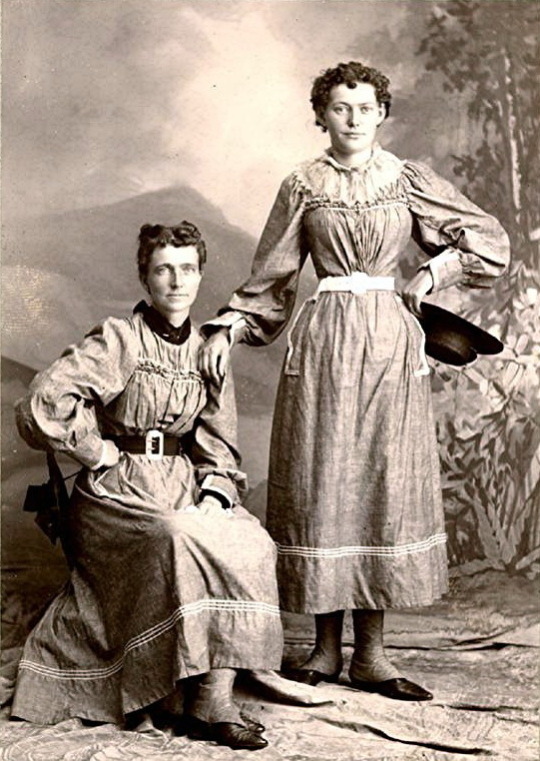
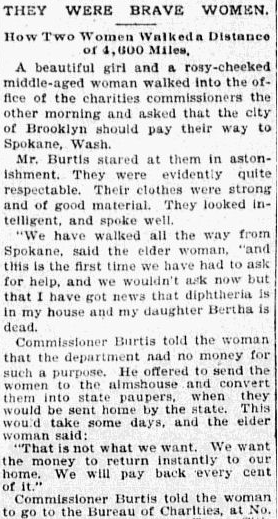
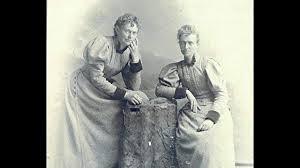
    Suffragist Helga Estby and her daughter, Clara, set off on an amazing journey in 1896, walking across the United States, but what should have been an inspiring tale ended in heartbreak.
     Helga was born in Norway 1860, and her hardship in life started early. Her father died when she was only two years old. Her mother remarried, but it was a time of economic turmoil and her stepfather had to leave the family to find work. He emigrated to the United states, sending for his family once he had found a stable home and employment for them. Helga was only 11 when she arrived in her new homeland, but she adapted quickly. She seems to have done well in school and became fluent in English.
    Five years later, Helga faced a crisis when she became pregnant. In this era, being an unwed mother was a terrifying and shameful situation. It must have been very difficult for her to admit her pregnancy to her family. The father of Helga’s child is nowhere mentioned in the historical records, but it can be assumed he either refused - or was unable - to marry Helga and make an “honest woman” of her. 
    Her family arranged a marriage with a man named Ole Estby and the baby, Clara, was born a month after the wedding. Ole took his bride and baby daughter out west to a homestead claim. They made their home in a prairie sod cabin. Clara probably learned to crawl on its dirt floor. It was a hard life, but they managed to make it work. Helga had three more children, Ole - named for his father - Olaf, and Ida. Young Ole died as an infant, as so many children of that era did.
    Adding to this grief were terrible trials such as wildfires which swept the area, fierce storms, and epidemics of disease. Ole finally had enough and packed up his family to move west again. As far as west goes, in their case, moving all the way to Spokane Falls, Washington. More children came along in due time.
    The family’s fortunes seemed to be improving. They bought lots in the thriving little town and Ole quickly found carpenter work. But then Helga fell on a dark night on the unlit streets. She was severely injured and had to have pelvic surgery, a severe blow to the family’s finances.
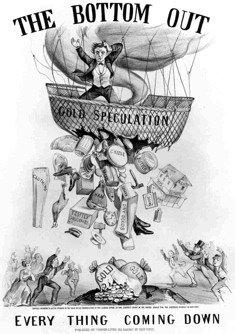
    In 1893, an economic depression hit the country hard. Banks in those days had very little regulation or oversight. Panics - financial collapses caused by unstable financial institutions - were frequent. But this one was particularly bad, caused by speculation on gold and the railroad-building bubble. Bank runs by people panicked their deposits would vanish if their local banks folded caused a ripple effect that spread across the nation. Unemployment skyrocketed.
    And then Ole himself was hurt, a debilitating injury that left him unable to work as a carpenter - not that there was much work to be had during the time. Helga later wrote an account of that dark time period:
For eight years we have had misfortunes. It was eight years ago that I fell one night over an obstacle in the streets of Spokane and was so badly injured that it made me sick for two years. Then I had an operation which laid me up a while and then cured me. About seven years ago my husband fell and fractured his knee cap. Afterward a horse fell on him and completely laid him up. Five years ago my daughter Ida went blind. She was treated in a hospital and is about well. Then my eldest boy got inflammatory rheumatism. Two years ago our house burned down, and as we had no insurance on it we only built up the kitchen part of it. 
   The family borrowed against their property to try to survive, but that short-term survival technique put their future in jeopardy. By 1896, Helga’s family was on the brink of ruin. They were facing foreclosure. 
    Helga learned of a sponsor in New York willing to pay $10,000 if a woman would walk across America. The details of the deal are sketchy - today, it’s unknown who it was who made the wager, or how Helga learned of it. She corresponded with the sponsor and a contract was drawn up. Helga had seven months to complete the task. Allowances would be made in the schedule for illness that occurred along the way.
    Helga was a strong woman and a supporter of the suffragist movement. She believed if she managed to accomplish the task, it would bring public awareness of the fact that women could do anything a man could do. She reassured her family somewhat in that she would not travel alone - she would take her eldest daughter, Clara, along on the trip. She secured an official letter of introduction from Spokane’s mayor, which would serve her credentials. 
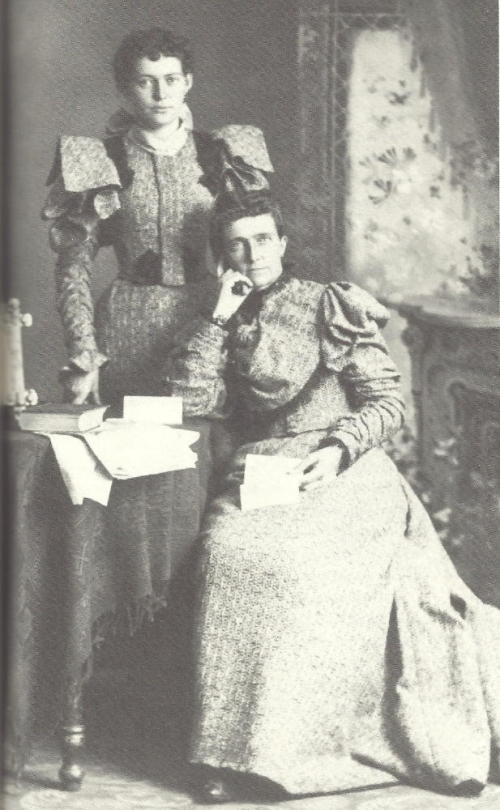
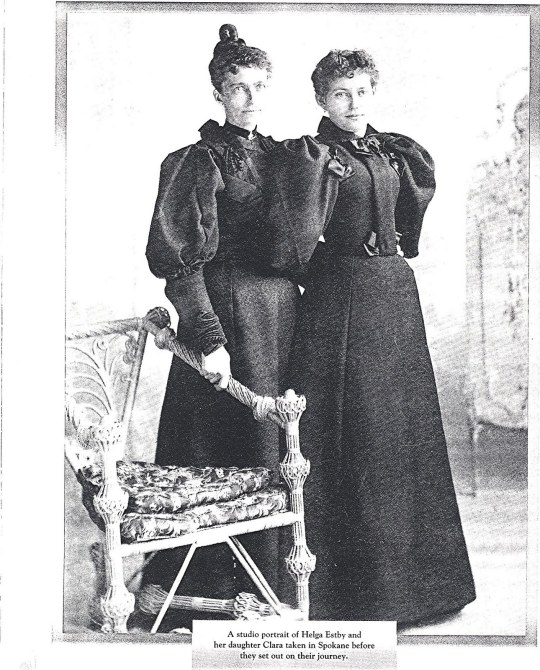
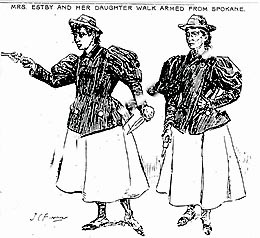
     After getting some photos of herself and her daughter printed up, she also had made some calling cards - those essential pieces of Victorian ladies’ paraphernalia - that read, “H. Estby and daughter. Pedestrians, Spokane to New York.” She hoped to sell the photos along the way to supplement their funds. They took no luggage with them, only a small satchel that contained a gun, a curling iron, a knife, a container of pepper spray, and a notebook so Helga could keep a journal of their travels. They had only five dollars cash, probably all the family could spare. The newspaper account announcing their journey hastened to add that they were respectable women, but would “rough it” like tramps for their trip.

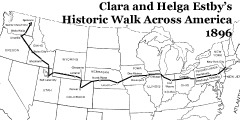
   It wasn’t an easy journey, by any means. Following the railroad tracks, Helga and Clara made their way east, stopping in towns along the way. There, they would first find the local newspaper reporter to give an account of their journey thus far. They would try to find temporary employment to feed themselves and sleep indoors, sewing, cooking and cleaning for their room and board. They did not ask for charity, but would gratefully accept lodging for the night if offered. On the whole journey, they only had to spend nine nights outdoors. 
    The articles about them continued to stress their respectability despite their unladylike travels. One article noted that Clara never drank anything other than milk and Helga only allowed herself one cup of coffee per day. Almost every article noted that Helga was an immigrant, and complimented her command of the English language.
    Along the way, they had to purchase new shoes and new clothing. They wore through 16 pairs of shoes apiece. At one point, the women abandoned the long dresses they had worn and adopted the new “bicycling costume” that women were wearing while riding bikes. It was more comfortable and more suitable for hiking, though it was not proper to be worn in any other context. (In other words, it was improper to wear it walking around a city or dining… Much like it would be today if someone were wearing a bathing suit to a restaurant.) 
    Helga and Clara were flouting convention in many ways, but Helga’s charm seems to have convinced newspaper editors who met her to present her in a positive light.
    They once nearly drowned in a flash flood and escaped a brush with a hungry cougar. At one point, Helga was attacked by a homeless man and ended up shooting him in the leg to escape. Helga also said they’d once been accosted by a group of Native Americans, who rifled through their pack and were fascinated by Clara’s curling iron. They were probably wondering why the women would lug such a thing around on a cross-country journey when they hadn’t even brought a change of clothing.
    But despite the hardships, they made across the country. On the last leg of their journey, Helga sprained her ankle. They wrote to the sponsor, asking for a an extension on order to give her time to heal. 
    They arrived in New York City the day before Christmas Eve, 1896, a little more than two weeks late, triumphant and exhausted. But to their shock, the sponsor refused to pay their $10,000 reward, citing the fact they were over their deadline. The contract had allowed for delays due to sickness, not for injury. The sponsor refused to even pay for Helga and Clara return trip home.
   They were stranded in New York for the winter. Helga found a publisher willing to pay her the money if she wrote a book about her experiences, but the journals she had carefully kept along the way were stolen or lost while they were in New York. 
    While they were there, Helga got the first letters from her family she had received in seven months. They contained the tragic news that her family had been stricken with diphtheria. One son was hospitalized and one daughter was dead.
    Finally, Helga reached out to a railroad owner, who took pity on their tragic tale and gave the women two tickets to ride his rail line as far as Minneapolis. The rest of their journey is lost to history, but they likely took a train the rest of the way back to Spokane.
    Without the promised reward, their property was foreclosed. Helga’s neighbors shunned her for “abandoning” her family for that crazy adventure. She had set out to prove that women could do anything, but in her neighbor’s minds, there were some things women should not do, and that included ladies leaving their home to go on an unchaperoned (and publicized!) journey across the US, leaving their children to suffer in their absence.
    Helga’s family eventually recovered from their financial hardships. Clara went off to college and became a successful businesswoman. Ole and one of his sons started a construction business, and the family settled into quiet prosperity. But more than one account says the family harbored resentment against Helga for her “abandonment” of them.
    Helga remained active in the suffragist movement, likely not endearing herself further to her neighbors. But she saw the triumph of the movement when women achieved the vote in Washington State in 1910.
   Starting in about 1920 Helga tried writing a book about her amazing journey, piecing the tale together bit by bit and using newspaper clippings to supplement her memories. She never finished it before her death in 1942. She had entrusted the memory of her story to one of her granddaughters, but the girl was unable to save her grandmother’s manuscripts and numerous newspaper clippings. One her family members gathered up the manuscript and burned it after her funeral, though the girl managed to snatch two clippings from the barrel before they burned. That was a common practice in the Victorian era, meant to protect the privacy of the dead.
    In the past few years, several books have been published about Helga and Clara’s amazing journey, and her courage is finally being recognized.
Share on Tumblr